Basics
How to Do Color Analysis on Yourself at Home (Step by Step)
Step-by-step color analysis at home: set up the light, find your undertone, depth and contrast, test colors in a mirror and confirm your season.
Bright Spring and Bright Winter are the two clearest, most vivid seasons. Both light up in saturated color and both look dull in dusty, muted shades. Because they share that sparkle, people often bounce between them. What separates them is temperature: Bright Spring leans warm, Bright Winter leans cool.
Bright Spring is bright and warm, like a tropical fruit bowl: coral, poppy red, bright yellow and kelly green. Bright Winter is bright and cool, like jewels on black velvet: hot pink, cobalt, emerald, black and optic white.
Do the tests in daylight with no makeup. Three or more results pointing one way is your answer.
Contrast is one of the easiest traits to misjudge. The personal contrast test checks it in five questions.
Six signature shades from each season, with hex codes. Both columns are vivid. The left one carries yellow warmth; the right one carries blue coolness and true black.
#E63946#FF6F59#FFD23F#2BA84A#00B4D8#FFFDF7#FF1F8E#D7002E#0047AB#009B77#000000#FFFFFF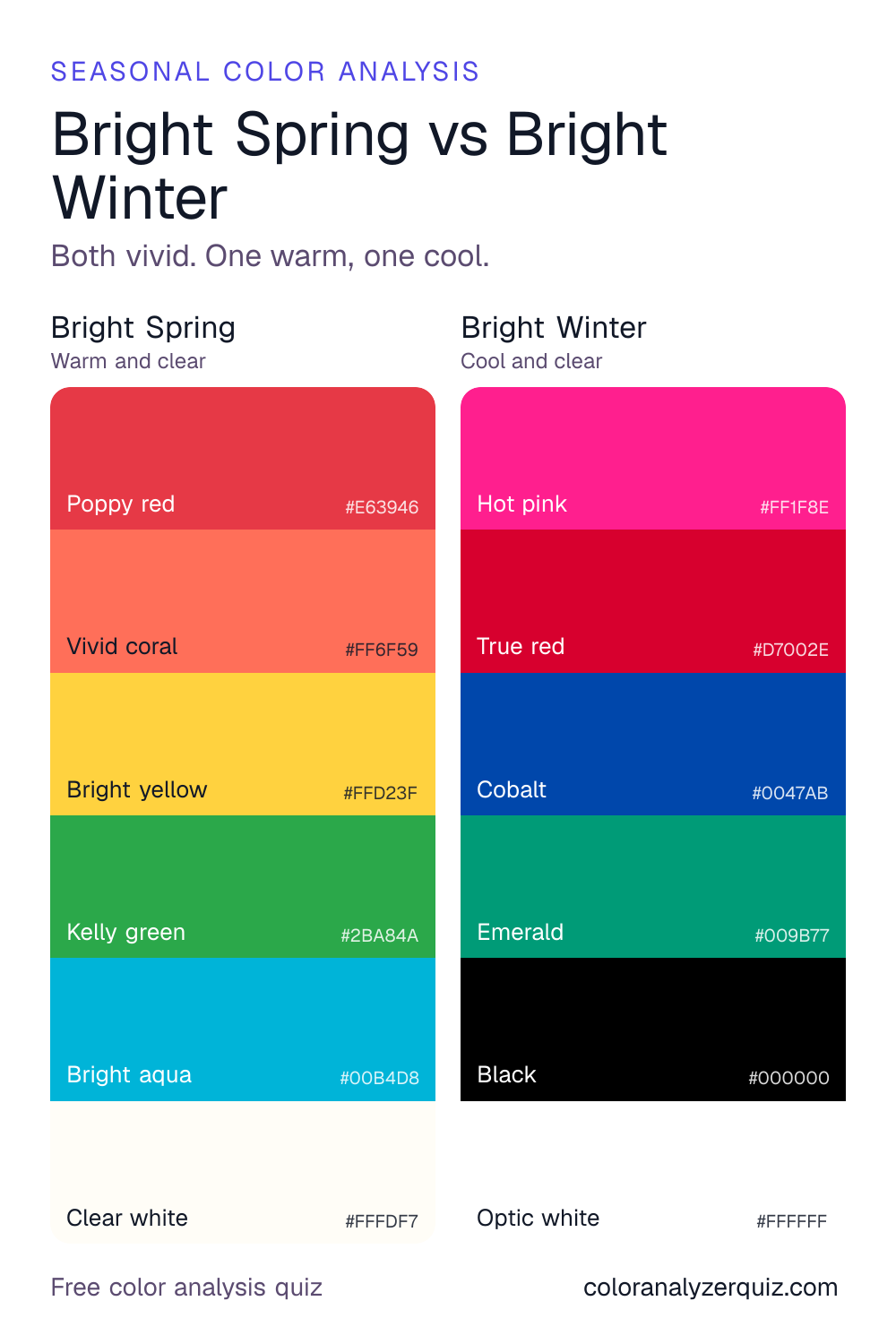
Bright Spring looks best in coral, warm pink and poppy red lips with bronze, warm teal or gold eyeshadow. Bright Winter looks best in fuchsia, blue-red and berry lips with charcoal, silver, plum or cobalt liner. For hair, Bright Spring suits golden brown, warm chestnut and copper highlights, while Bright Winter suits espresso, soft black and cool dark brown.
For Bright Spring, build around bright navy, charcoal and clear white, with coral, kelly green and bright aqua as accents. For Bright Winter, build around black, charcoal and optic white, with hot pink, emerald and cobalt as accents. A cobalt piece is a safe first buy while you decide.
Build more combinations from any of these shades with the color harmony generator.
If both sides look good, you may be close to neutral. Stay with the shared shades, such as cobalt, bright teal, true red with a slight warm or cool lean, and charcoal. Then let your jewelry decide the outfit.
The Bright Spring and Bright Winter guides each have 12 hex codes, outfit combinations, makeup and hair colors. Still unsure whether you are a bright season? The photo color analysis checks your contrast and clarity, and the six-question season quiz works without a photo.
Basics
Step-by-step color analysis at home: set up the light, find your undertone, depth and contrast, test colors in a mirror and confirm your season.
Basics
Looking for a color analysis app? How phone color analysis works, what to look for (privacy, 12 seasons, lighting) and how to use a free one.
Undertones
How to do the white paper undertone test step by step, what pink, yellow, green or grey results mean, common mistakes, and how to confirm your result.
More free color analysis tools. Each one runs in your browser, with no sign-up.
Upload a selfie and get your color season.
Six questions, no photo: find your color season.
Low, medium or high contrast? How to dress it.
Every season palette with hex codes.
Your skin tone and undertone from a photo.
Warm, cool or neutral? Plus your best colors.
Warm, cool, neutral or olive foundation?
Concealer shade and color corrector for you.
Find the jewelry metal that flatters you.