Basics
How to Do Color Analysis on Yourself at Home (Step by Step)
Step-by-step color analysis at home: set up the light, find your undertone, depth and contrast, test colors in a mirror and confirm your season.
Dark Autumn and Dark Winter (also called Deep Autumn and Deep Winter) are neighbours on the color wheel. Both have deep coloring and both look powerful in rich, dark shades. That is exactly why people swap between them. The good news is that one question settles it: does your coloring lean warm or cool?
Dark Autumn is deep and warm, with an earthy, slightly muted richness. Dark Winter is deep and cool, with a crisp, jewel-like clarity. Dark Autumn looks like a forest in October; Dark Winter looks like a night sky with jewels in it.
Do the tests in daylight with no makeup. If three or more point the same way, you have your answer.
Contrast is one of the easiest traits to misjudge. The personal contrast test checks it in five questions.
#5C3A21#9C3D2E#B8541B#C79A1E#5E6B2E#2E5939#141414#FAFAFA#C8102E#00704A#4B2C82#C2185B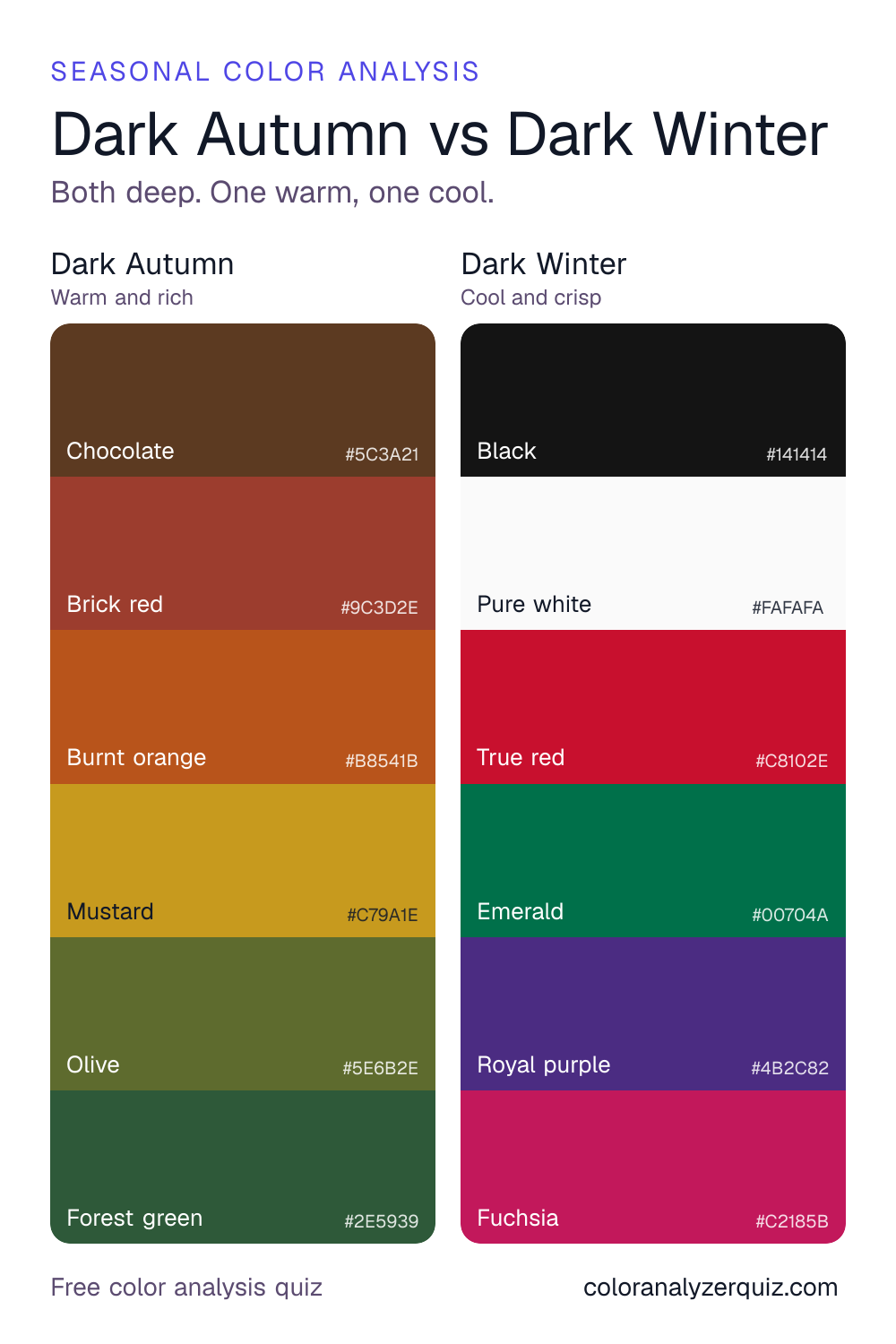
Burgundy appears in both, which is a good clue. If you look great in burgundy but cannot decide on the rest, use the neutral and white tests above, because they show the warm and cool difference most clearly.
Dark Autumn looks best in bronze, copper and olive eyeshadow, warm brick lips and chocolate liner. Dark Winter looks best in charcoal, plum and silver eyeshadow, berry or blue-red lips and crisp black liner. For hair, Dark Autumn suits chocolate, mahogany and deep auburn, while Dark Winter suits espresso, soft black and cool dark brown.
For Dark Autumn, build around espresso or chocolate trousers, a camel or olive coat, cream knitwear, and a few rich accents such as burgundy, rust or deep teal. For Dark Winter, build around black or charcoal trousers, a navy or black coat, crisp white shirts, and jewel-tone accents such as emerald, royal purple or true red. Either way, a burgundy piece is a safe first buy while you are still deciding.
Build more combinations from any of these shades with the color harmony generator.
Some people are close to the line, often with neutral or olive undertones. In that case, stay with the colors both palettes share: burgundy, deep teal, navy and dark charcoal. Then lean warm or cool depending on the outfit and your jewelry.
The Deep Autumn guide and the Deep Winter guide each have 12 hex codes, outfit combinations, makeup and hair colors. Not sure you are a deep season at all? Try the free color analysis quiz or the what season am I quiz.
Basics
Step-by-step color analysis at home: set up the light, find your undertone, depth and contrast, test colors in a mirror and confirm your season.
Basics
Looking for a color analysis app? How phone color analysis works, what to look for (privacy, 12 seasons, lighting) and how to use a free one.
Wardrobe
The best colors to wear for interviews and video calls, what each color says, colors that look bad on camera, and how to choose for your skin tone.
More free color analysis tools. Each one runs in your browser, with no sign-up.
Upload a selfie and get your color season.
Six questions, no photo: find your color season.
Low, medium or high contrast? How to dress it.
Every season palette with hex codes.
Your skin tone and undertone from a photo.
Warm, cool or neutral? Plus your best colors.
Warm, cool, neutral or olive foundation?
Concealer shade and color corrector for you.
Find the jewelry metal that flatters you.