Makeup
Best Lipstick Color for Your Skin Tone (With Hex Codes)
The best lipstick colors for fair, medium, tan and dark skin and for warm, cool, neutral and olive undertones: nudes, reds and berries with hex codes.
A foundation match has two parts: depth (how light or deep the shade is) and undertone (the color underneath). Most people get the depth roughly right and the undertone wrong, which is why a foundation can be the right lightness but still look orange, pink or grey. Find the undertone first, then the depth, then test.
Want a quick answer first? The foundation shade finder asks five questions and tells you your undertone family, depth range and which shade labels to look for.
Check these in daylight with a bare face. Two or three signs that agree are enough.
The undertone test and the guide to warm or cool undertones explain each check in more detail.
Depth is how light or deep your skin is, usually split into fair, light, medium, tan and deep. Judge it on your jaw and neck, not your cheeks, which are often redder or darker. If you are between two depths, start with the lighter one: a slightly light foundation looks more natural than one that is too dark.
#F1D2BF#E8BF98#E6BCAE#DCC098#C99467#C69477#B99A6E#A8703F#A6705C#6A4430#6E4423#604A2E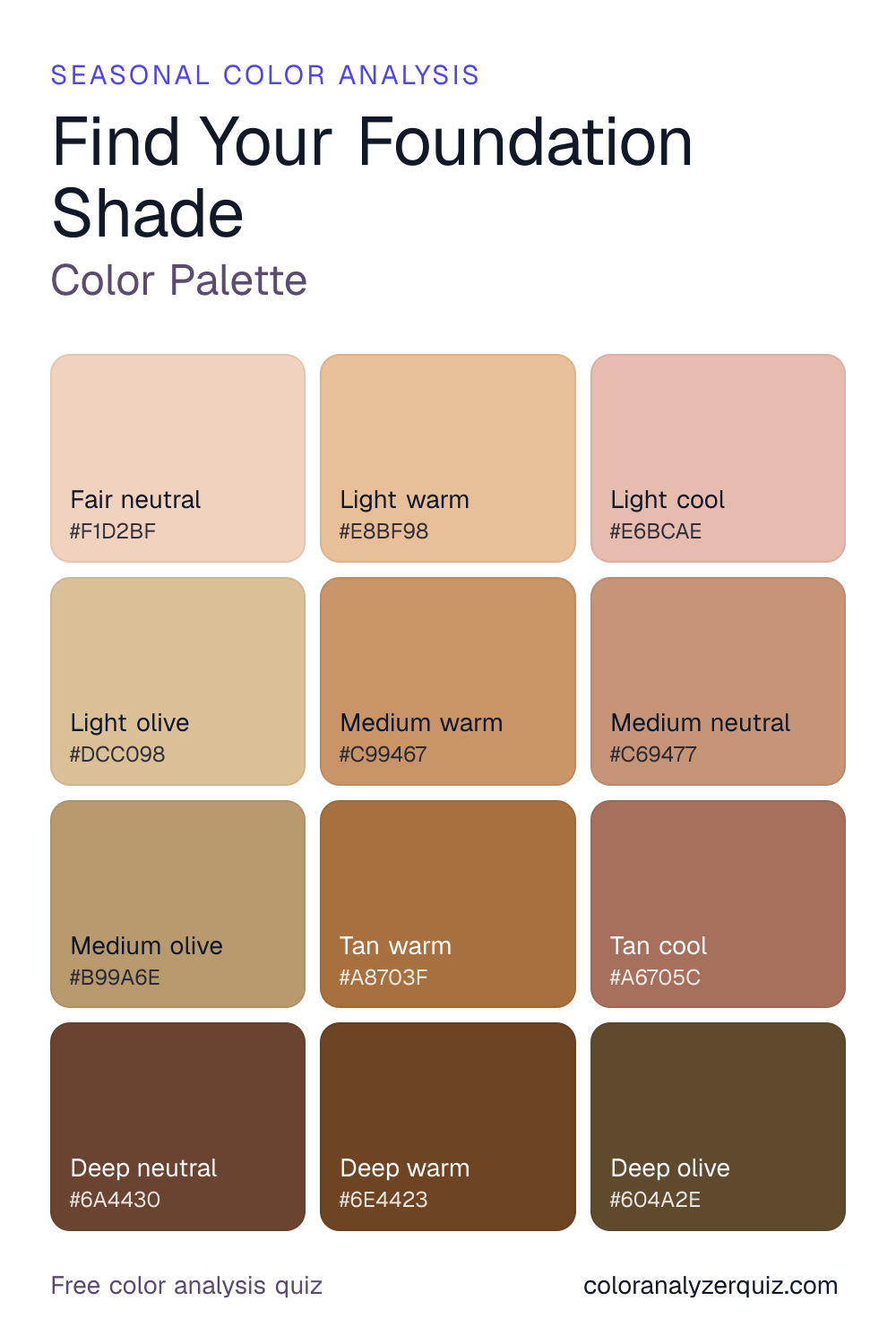
These are reference swatches, not brand shades. Screens show color differently, so use them to understand the families, not to buy from.
Shopping online? Compare the brand's swatch on a model with a similar depth and undertone, and check reviews from people who say their own shade in another brand. Many brands also offer their own shade-matching quiz; use it together with your undertone result.
Your foundation undertone points to your color season family: warm usually means Spring or Autumn, cool means Summer or Winter, and neutral or olive often means a soft season. The free photo color analysis adds depth and contrast to find your full season, and the makeup color palettes show the lipstick and blush that go with it. For concealer, use the concealer shade finder.
Olive skin has its own guide: foundation for olive skin.
Find your undertone first (warm, cool, neutral or olive), then your depth (fair to deep). Swatch three shades in your undertone on your jaw, wait 10 minutes and check in daylight. The one that disappears is your match.
Match your jaw and neck. Faces are often redder or darker than the neck, and a foundation matched to the cheeks can leave a visible line at the jaw.
It is usually too warm, too deep, or it has oxidized as it dried. Try a neutral shade one step lighter and always check after 10 minutes.
Yes, roughly. Know your undertone and depth, compare swatches on models with similar skin, and use the brand's shade chart. If possible, order a sample or two neighboring shades first.
Your undertone stays the same, but your depth can change with a tan. Many people use a slightly deeper shade in summer, or mix two shades as their skin changes.
Makeup
The best lipstick colors for fair, medium, tan and dark skin and for warm, cool, neutral and olive undertones: nudes, reds and berries with hex codes.
Makeup
Winter makeup colors with hex codes for Deep, Cool and Bright Winter: true red, berry and fuchsia lipstick, cool pink blush, charcoal and navy eyeshadow.
Wardrobe
Which purple suits you: lavender, lilac, dusty purple, plum, violet or indigo, by undertone and color season, with hex codes.
More free color analysis tools. Each one runs in your browser, with no sign-up.
Upload a selfie and get your color season.
Six questions, no photo: find your color season.
Low, medium or high contrast? How to dress it.
Every season palette with hex codes.
Your skin tone and undertone from a photo.
Warm, cool or neutral? Plus your best colors.
Match your foundation undertone and depth
Concealer shade and color corrector for you.
Find the jewelry metal that flatters you.