Wardrobe
Color Analysis for Clothing: How to Pick Colors That Suit You
How to use color analysis for clothing: wear your palette near your face, choose neutrals for your season, shop with hex codes and build outfits.
Some outfits look effortless and others look slightly off, even when every piece is nice on its own. Usually the difference is color. A few simple rules from color theory explain which colors go together in clothes, and once you know them you can build outfits from your own wardrobe without guessing.
This guide covers the main types of color combinations, easy rules for balancing them, combinations that almost always work, and how to adapt them to your color season.
You can try any color with the color harmony generator: it shows complementary, analogous and triadic matches with hex codes.
These twelve colors combine easily with each other and appear in almost every wardrobe. The exact shade that suits you depends on your season.
#1F3A5F#C19A6B#F3E9D2#8C8C8C#141414#4A6E94#708238#B7410E#D4A017#7B1E2B#009B77#E8B4B8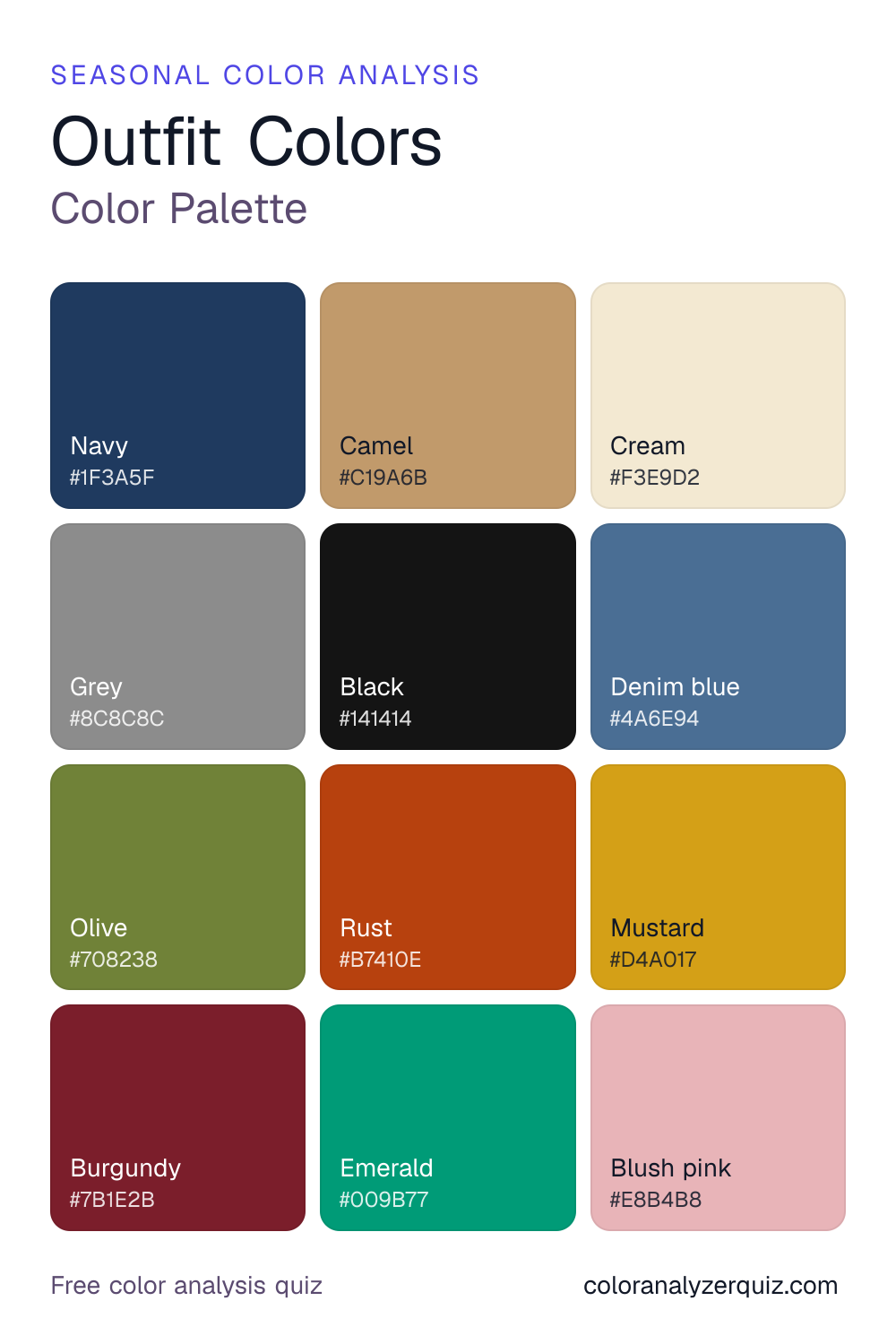
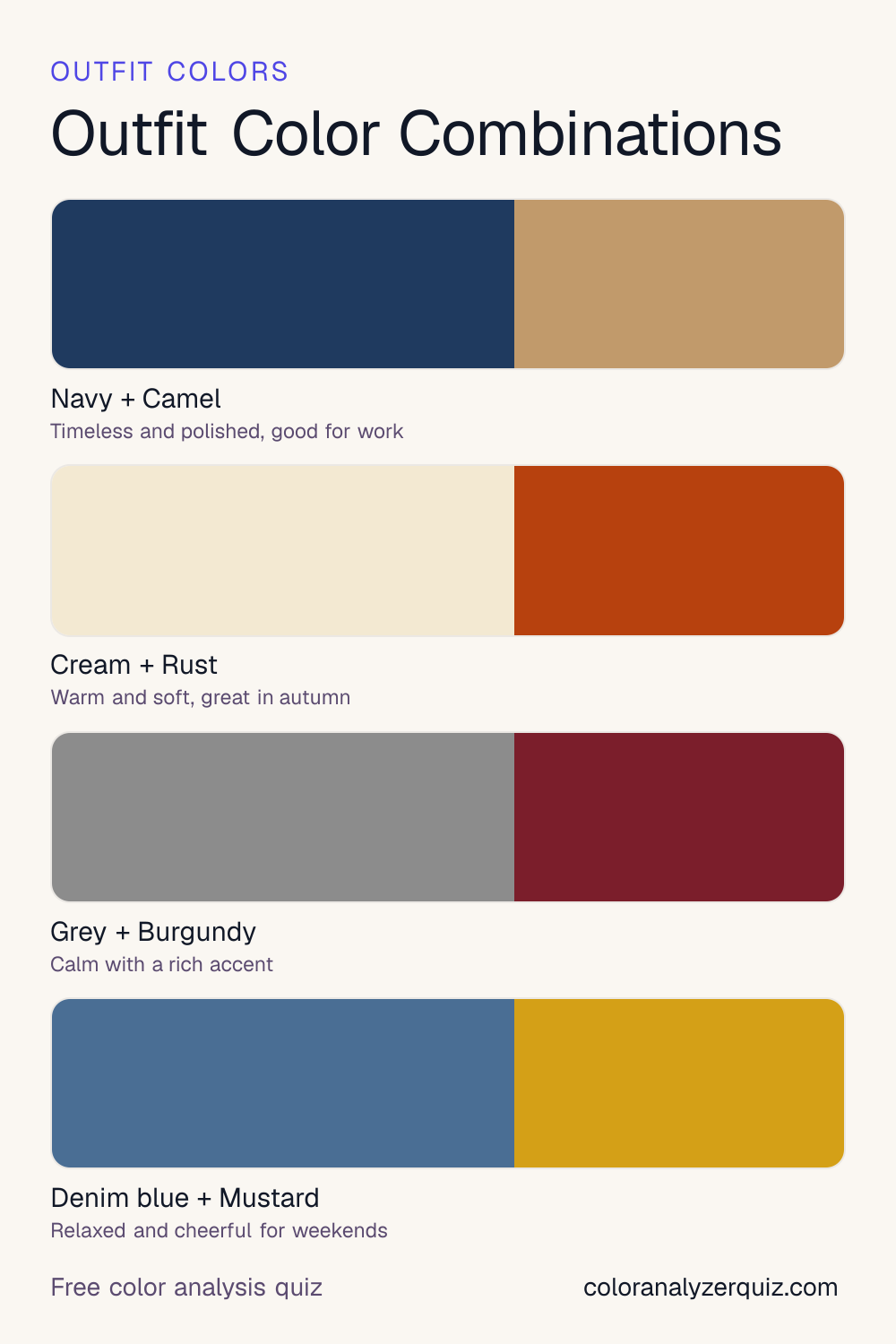
Complementary pairs look best when one color is darker or more muted than the other, or when one is only an accent. For one of the most useful base colors, see what colors go with navy, and for black, can you wear black?, and for green, what colors go with green.
The same combination can look great on one person and dull on another. Choose the version of each color that matches your season:
Shopping online? Paste the product color into the color checker to see if it fits your season. For a full wardrobe plan, read building a capsule wardrobe around your color season.
A neutral with one color is the safest choice. Monochrome shades, colors next to each other on the color wheel, and muted complementary pairs like navy with rust also work well.
About 60% of the outfit in a main color, 30% in a second color and 10% in an accent. It keeps outfits balanced and easy to read.
Camel, cream, white, blush pink, light blue, burgundy, mustard and rust all pair well with navy.
Yes, but it works best when they are close on the color wheel or when one is used only as an accent. Keep the rest of the outfit neutral.
Combinations look best when every color also suits your skin. Try the free photo color analysis or the six-question season quiz to find your palette.
Wardrobe
How to use color analysis for clothing: wear your palette near your face, choose neutrals for your season, shop with hex codes and build outfits.
Wardrobe
The best colors to wear for interviews and video calls, what each color says, colors that look bad on camera, and how to choose for your skin tone.
Undertones
Have a warm skin tone? The best colors for warm undertones with 12 hex codes, colors to avoid, outfit ideas, makeup, hair and jewelry, from fair to deep skin.
More free color analysis tools. Each one runs in your browser, with no sign-up.
Upload a selfie and get your color season.
Six questions, no photo: find your color season.
Low, medium or high contrast? How to dress it.
Every season palette with hex codes.
Your skin tone and undertone from a photo.
Warm, cool or neutral? Plus your best colors.
Warm, cool, neutral or olive foundation?
Concealer shade and color corrector for you.
Find the jewelry metal that flatters you.