Makeup
Foundation for Yellow Undertones: How to Find Your Match
How to choose foundation for yellow undertones: which shade labels to look for, golden reference shades with hex codes, and how to avoid orange or grey results.
The right concealer shade depends on where you use it. Under the eyes, you want a shade slightly lighter than your skin to brighten; on spots and redness, you want an exact match so it disappears. Get the undertone right and both look natural. Want a quick answer? Take the free concealer shade finder.
Start from your foundation, or from your skin if you skip foundation. Your concealer should share its undertone: golden (W or Y), pink (C or R), neutral (N) or olive (O). A pink concealer on golden skin looks grey; a yellow one on pink skin can look sallow. Not sure? Use the undertone test or read how to find your foundation shade.
| Where | Shade | Why |
|---|---|---|
| Under the eyes | 1 shade lighter than foundation (2 at most) | Brightens shadows without a white ring |
| Spots and blemishes | Exact foundation match | Lighter shades make spots stand out |
| Redness around the nose | Exact match, or green corrector first | Hides redness without a grey cast |
| Highlighting (forehead, chin) | 1 to 2 shades lighter | Adds lift; blend well |
Deep skin usually looks best with concealer only half a shade lighter, or the same shade over a peach or orange corrector, because very light concealer turns ashy on deep skin.
#F4C7A1#E8A07A#D9733E#B5482E#9DBF8E#C9B6E4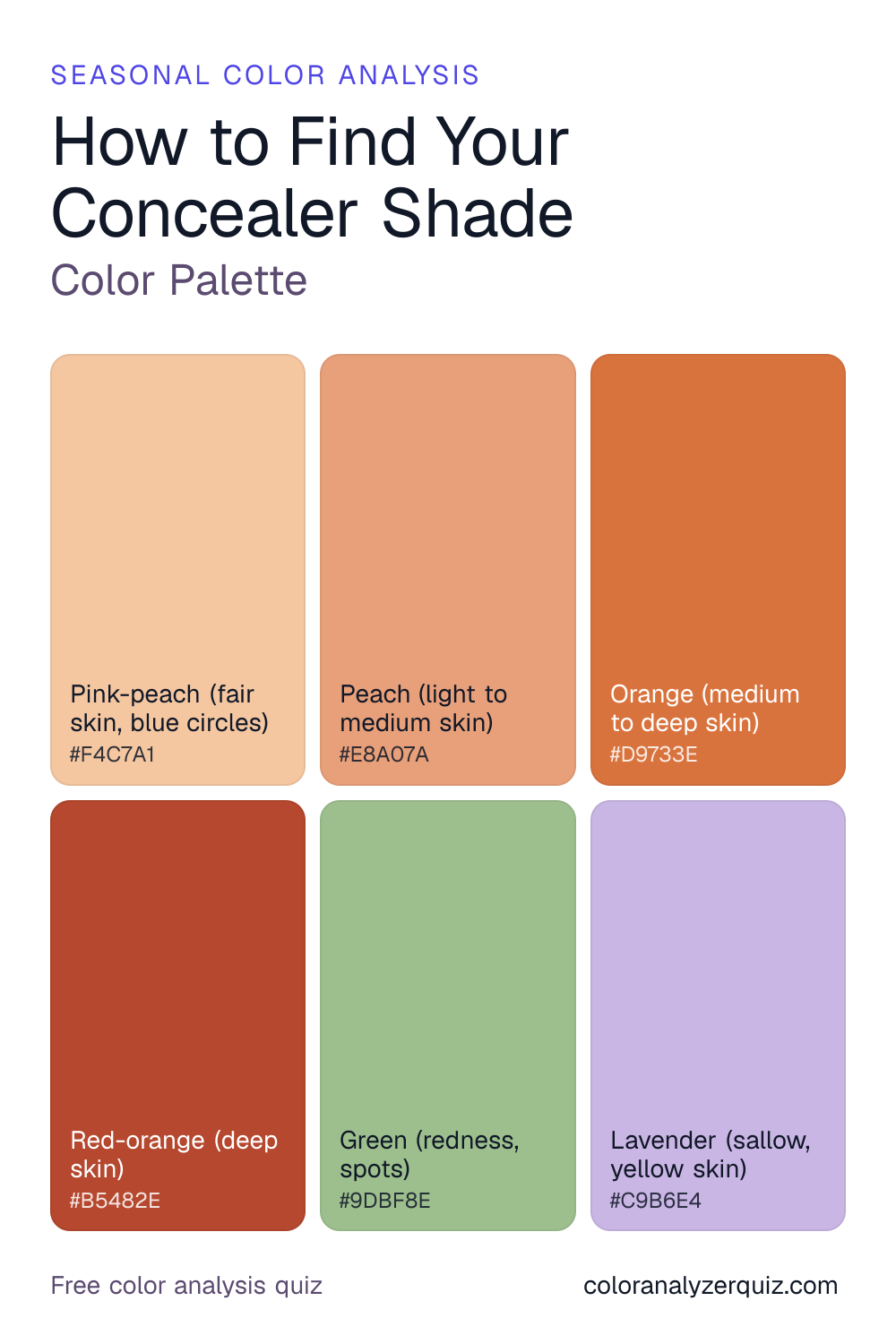
Correctors cancel the opposite color: peach and orange cancel blue-purple dark circles, green cancels red, and lavender cancels yellow. Use a thin layer, then concealer on top. More detail: concealer color for dark circles.
For under the eyes, one shade lighter than your foundation in the same undertone; for spots, your exact foundation shade. The free concealer shade finder narrows it down in six questions.
Under the eyes, yes: about one shade lighter. For blemishes, no: use the same shade as your foundation.
A peach corrector for light to medium skin, orange or red-orange for deep skin, then a concealer one shade lighter than your skin.
Makeup
How to choose foundation for yellow undertones: which shade labels to look for, golden reference shades with hex codes, and how to avoid orange or grey results.
Makeup
The best lipstick colors for fair, medium, tan and dark skin and for warm, cool, neutral and olive undertones: nudes, reds and berries with hex codes.
Undertones
What a warm ivory skin tone is, the best clothing colors with hex codes, makeup and foundation tips, colors to avoid and likely color seasons.
More free color analysis tools. Each one runs in your browser, with no sign-up.
Upload a selfie and get your color season.
Six questions, no photo: find your color season.
Low, medium or high contrast? How to dress it.
Every season palette with hex codes.
Your skin tone and undertone from a photo.
Warm, cool or neutral? Plus your best colors.
Match your foundation undertone and depth
Concealer shade and color corrector for you.
Find the jewelry metal that flatters you.